Sandbox In Space
- 4.4
- Rating
- 10.00M
- Installs
- Free
- Price

 Analysis by App-foxy
My first few minutes with Sandbox In Space were less about winning and more about understanding what kind of game I had opened. It is a simulation game built around a space sandbox, but it does not treat space as a quiet place for careful scientific experiments. Instead, it throws together open-ended play, nextbots, skibidi toilet references, and the unpredictable energy associated with gmod-style chaos. The result is deliberately strange, noisy, and loose.
That combination matters because this is not the kind of mobile game I would recommend to someone looking for a polished campaign with a clear beginning, middle, and end. I see it more as a digital toy box. You enter, create trouble, watch objects and characters react, and decide whether the moment is funny or interesting enough to continue. When the mood clicks, it is easy to lose time experimenting. When it does not, the lack of a strong guided structure can feel like a weakness.
The game is free to download, which makes trying it straightforward, although optional in-app purchases range from under a dollar to almost a hundred dollars per item. It is aimed at a Teen audience, and I think that label is useful: the tone is cartoonish and internet-driven, but the references and chaotic presentation will not appeal equally to younger children or to players who prefer a calmer simulation. HOOKAH GAMES IT SERVICE L.L.C is the developer, and the game has built a sizable audience, with more than ten million installs and an average rating of 4.2 from roughly ninety-one thousand ratings.
You May Also Like

 Blood Strike: 2.5 Anniversary
Blood Strike’s Loadouts Turn Every Drop Into a Tactical Gamble
A close look at Blood Strike’s custom loadouts: how fast access to signature weapons reshapes its battle royale rhythm, rewards preparation, and narrows the gap between fights.

 Pandora - Music & Podcasts
Pandora’s Music Is Easy to Start, but Harder to Recover
Pandora’s strength is its low-effort path from a seed to a station. Its weak spot is how much confidence it asks you to place in connection, setup, and quiet recovery.

 8 Ball Pool
 Is Built on Rivalries, Rematches, and Routine
A close look at the rivalries, rematches, shared routines, and unanswered safety questions that turn a quick pool match into a persistent mobile community.

 Samsung Music
’s Quiet Strength Is Playing What You Already Own
Its reach comes less from spectacle than from dependable access to a personal library. That simplicity is both the app’s strongest retention engine and its ceiling.

 AccuWeather: Weather Radar
AccuWeather Review: A Quick, Clear Forecast for Everyday Decisions
For everyday plans, the best forecast is the one you can understand quickly. AccuWeather makes rain timing, radar, and local conditions easy to act on, with a few trade-offs.

 Hill Climb Racing
Why Hill Climb Racing Still Turns Crashes Into One More Run
A tiny car, a bumpy hill and one more upgrade: Hill Climb Racing keeps resurfacing because its simple chaos makes every near-miss feel personal.
More From Our News Desk



How the space setting shapes the game’s personality
I find the space setting most useful as a change of pace: it gives the game’s odd encounters room to feel sudden, while keeping the focus on playful experimentation rather than realism. That also makes it worth thinking about how to approach a session, especially if you want the freedom to feel creative instead of aimless.
A world designed for collision rather than realism
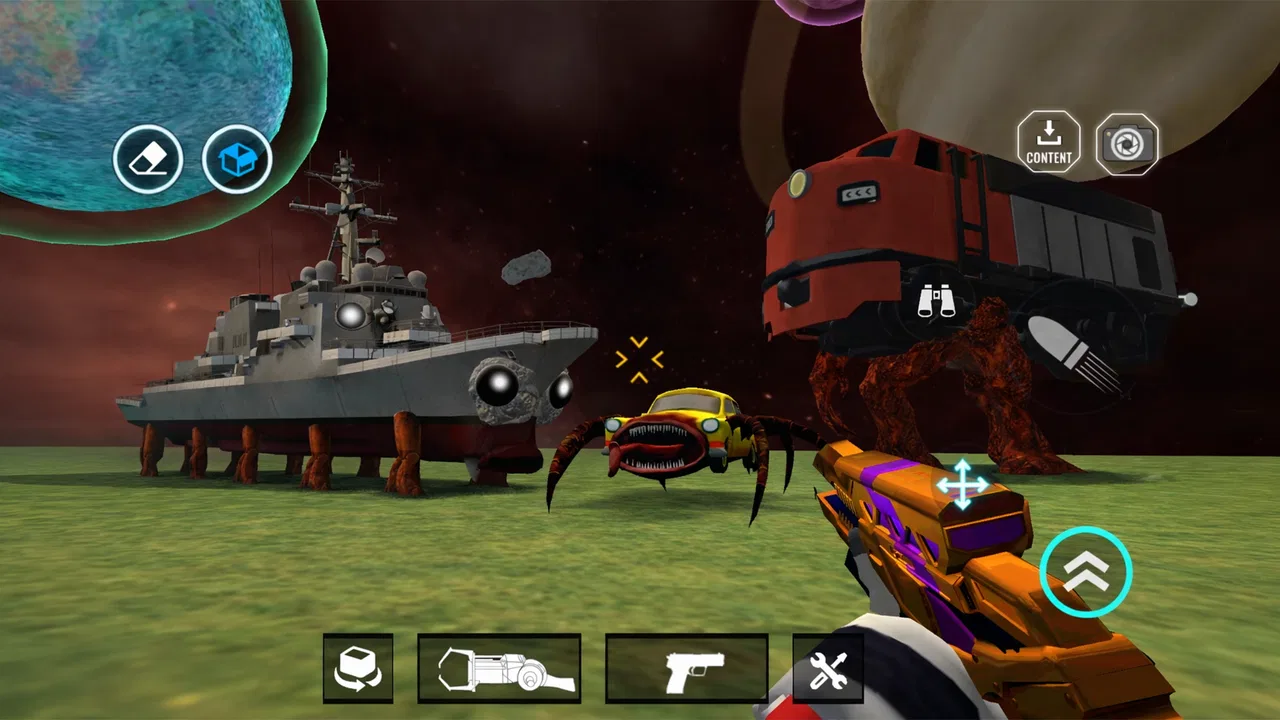
The strongest artistic choice is the contrast between the setting and the behavior it invites. Space usually suggests silence, distance, and careful movement. Here, that emptiness becomes a stage for absurd encounters. The setting gives the game room to feel unpredictable: there is a sense that something can appear from outside the frame, drift into the action, or turn a simple experiment into a ridiculous scene.
I would not describe the visual direction as realistic space simulation. The appeal is closer to a playful sandbox where recognizable internet-style characters and bizarre situations share the same environment. That gives the game a very specific identity. It is not trying to compete with serious orbital simulators, and it is not simply another physics toy with a space background. Its personality comes from placing chaotic, familiar, and intentionally silly ideas in an environment that normally feels grand and controlled.
That contrast also affects how I play. In a conventional simulation, I might approach each system with a plan and judge success by accuracy. Here, I am more likely to test what happens when I disturb the scene, bring elements together, or allow a situation to develop without trying to control every detail. The lack of pressure makes experimentation approachable, but it also means the game depends heavily on my own imagination.
Visual language that supports quick experiments
The art direction works best when I treat every scene as a small performance. The visual elements do not need to tell a deep story; they need to be readable enough for me to understand what is happening while still leaving space for surprise. That is especially important in a sandbox, where the player is often watching several moving parts instead of following a single hero.
There is a useful trade-off here. A highly detailed presentation could make the game look more impressive, but it might also make the chaotic interactions harder to read. The looser style helps the action remain immediate. I can focus on the oddity of the situation rather than stopping to admire realistic surfaces or complicated scenery. For players who enjoy meme culture and exaggerated visual humor, this directness is part of the charm.
On the other hand, anyone hoping for a rich science-fiction world with carefully layered lore should adjust expectations. The space setting is mainly a playground, not a narrative universe that I explore for history or character development. The game’s visual language says, “try something strange,” rather than, “study this world.” That makes it more accessible for short sessions, but less satisfying for players who need a strong fictional setting to keep them invested.
Why the references are both a strength and a limitation
The inclusion of nextbots and skibidi toilet material gives the game an immediate cultural flavor. I do not have to wonder whether the tone is serious. It announces itself as internet-native, exaggerated, and happy to be ridiculous. That can make the first session memorable because the game has a recognizable attitude instead of presenting itself as a generic space sandbox.
Still, references like these can age faster than the underlying mechanics. If a player is already tired of this style of humor, the setting may feel noisy rather than entertaining. I also think the game works better when I accept the references as seasoning instead of expecting them to carry the entire experience. The sandbox interactions need to provide enough amusement on their own; otherwise, the novelty of the characters can fade quickly.
Sound, pacing, and the feeling of a live toy box
The audio and pacing are important because this game is built around moments rather than a traditional progression curve. A quiet, slow presentation would make the empty space feel passive. The energetic tone instead encourages me to keep moving, testing, and reacting. Even when I am not pursuing a specific objective, the game feels more like an active playground than a static display.
What I appreciate is the way the mood supports quick decisions. I can start a session with no detailed plan, try one interaction, and immediately decide whether to continue. That is a good fit for mobile play. If I have a few minutes while waiting for something, I do not need to remember a complicated storyline or rebuild a long-term strategy before I can enjoy myself.
The same pacing can become tiring during longer sessions. Constant absurdity has less impact when it never gets a chance to contrast with calm. A game that stays at maximum chaos can make individual moments blur together. I found that the experience is stronger when I create my own pauses: observe what is happening, make one deliberate change, and then let the scene unfold instead of tapping randomly at everything.
This is one of the more useful ways to approach the game. Rather than treating it as an endless stream of jokes, I treat each session as a short experiment with a beginning and an ending. I set up a situation, watch the result, and stop when the scene has reached its funniest or most interesting point. That simple habit gives the pacing more shape and prevents the sandbox from feeling directionless.
What the mechanics need from the player
The mechanical appeal comes from freedom. I am not being pushed through a fixed mission sequence, so I can decide whether I want to create a spectacle, explore the available space, or simply see how the game behaves when I interfere with a situation. This makes the game approachable for curious players who enjoy asking “what happens if I do this?” more than following instructions.
That freedom also creates the central trade-off: the game gives me room to play, but it does not automatically give every session a purpose. In a traditional simulation, goals often come from managing resources, completing tasks, or improving a measurable result. Here, the goal may simply be producing a funny scene. That is valid, but it depends on whether I enjoy self-directed play.
For a better experience, I recommend giving each session a small personal challenge. I might try to create the most crowded scene I can manage, observe one character or object without interfering, or see how long I can keep a situation interesting before resetting it. These are not formal missions; they are ways of turning open-ended mechanics into a more satisfying routine. The game becomes less like waiting for content and more like using a set of tools.
Another practical tip is to avoid judging the game by the standards of a serious physics simulator. If I expect exact scientific behavior, I am likely to focus on what feels loose or exaggerated. If I approach it as an entertainment sandbox, the same looseness becomes part of the fun. The right question is not whether it models space with academic precision, but whether its reactions give me enough control and surprise to keep experimenting.
How it compares with other simulation choices
Compared with a conventional space simulation, this game is much less concerned with education, realism, or long-term planning. A serious alternative is better for someone who wants to understand orbital movement, build a carefully managed mission, or feel responsible for a complex system. Sandbox In Space is better when I want immediate interaction and comic unpredictability without studying a manual first.
Compared with a standard physics sandbox, its space setting and internet-inspired cast give it a clearer mood. A general physics toy may offer more neutral experimentation, while this game frames experiments through absurd characters and chaotic encounters. That makes it more memorable for players who want a strong theme, but potentially less appealing to someone who prefers a clean, tool-focused environment.
It also differs from mission-based mobile games because progress is not the only reason to return. I can play for a short burst without worrying about failing a level or losing a carefully built campaign. The downside is that players who rely on unlocks, story chapters, or a constantly rising difficulty curve may feel that the game does not provide enough direction. Choosing this title over another simulation really comes down to whether freedom or structure matters more to me.
A realistic everyday use case
Imagine I have ten minutes before an appointment. I do not want to start a story game because I may need to stop suddenly, and I do not want to enter a competitive match where leaving early affects other players. This is where the sandbox format makes sense. I can open the game, create a small chaotic setup, watch the results, and close it without feeling that I abandoned a larger commitment.
For a longer evening session, I would use it differently. I would make a few themed experiments instead of tapping through random interactions. First, I might build a scene around one unusual character. Then I would change the environment or introduce another source of disruption and compare the result. Finally, I would reset everything and try to reproduce the most entertaining moment. That approach gives me a personal rhythm and makes the game feel more creative than passive.
It could also work as a casual game to share with a friend who enjoys internet humor. The appeal is easy to demonstrate because the strange situations are visible quickly. However, I would not recommend it as a cooperative planning game or as a deep social experience. Its strength is the spectacle created by the player, not a carefully organized group objective.
Who will enjoy it, and who should skip it
I think the best audience is made up of players who like open-ended mobile toys, absurd humor, and short sessions with no strict win condition. It is especially suitable for someone who enjoys experimenting without worrying about doing things “correctly.” The Teen rating also gives a useful indication of its intended tone, so I would be cautious about recommending it to younger children simply because the visuals look cartoon-like.
I would suggest skipping it if you want a calm, realistic, educational space experience. It is also a poor fit if you need a clear progression system to maintain interest. Players who dislike nextbot-style tension, skibidi toilet references, or gmod-inspired chaos may find the core presentation irritating rather than funny.
There is another group that may want to try it but should keep expectations modest: players who enjoy sandbox games but dislike spending money inside free titles. The game itself costs nothing to start, yet the available purchases can reach a high per-item price. I recommend playing the free experience first and deciding whether the added options genuinely improve the way you play, rather than buying impulsively because a chaotic scene feels exciting in the moment.
Performance expectations and practical patience
The current version is 3.22.1, and the game supports devices running Android 7.0 or later. That makes it available to a broad range of Android users, but compatibility alone does not tell me how every device will handle a busy sandbox scene. When many elements are active, I would keep an eye on responsiveness and avoid assuming that a phone that handles simple games smoothly will behave exactly the same under heavier chaos.
My practical advice is to begin with smaller experiments. Start with a limited scene, learn how the controls respond, and add complexity gradually. This is useful for two reasons: it makes the action easier to understand, and it helps reveal whether my device remains comfortable before I create a crowded situation. It also improves the gameplay itself, because I can identify which change caused an interesting result instead of losing track of everything at once.
The free entry point lowers the risk of trying it, but the game’s value depends on personal tolerance for repetition. A sandbox can remain entertaining for a long time when I enjoy inventing scenarios. If I need the game to surprise me with a new formal objective every few minutes, the open structure may feel thin. That is not a flaw in every context; it is simply the cost of choosing a toy-like design over a guided one.
My final view of the atmosphere
What stays with me is the unusual mood created by the combination of empty space, exaggerated characters, and uncontrolled-looking action. The art direction gives the game a recognizable face, while the pacing keeps sessions immediate. The mechanics support that mood because they let me turn the setting into a stage for experiments instead of asking me to follow a rigid route.
Its limitations are closely connected to its strengths. The same freedom that makes a short session easy can make a long session feel aimless. The same internet humor that gives the game personality can become distracting if I do not enjoy the references. The same loose, chaotic presentation that encourages funny accidents will not satisfy a player searching for scientific accuracy or carefully balanced simulation systems.
After spending time with it, I see Sandbox In Space as a good recommendation for a specific kind of player, not a universal simulation choice. I would send it to a friend who likes creating ridiculous scenes, watching systems behave unexpectedly, and playing without the pressure of a campaign. I would point a realism-focused player toward a more technical alternative instead. For me, the game succeeds when I approach it as a compact mood machine: open the space, introduce a little disorder, wait for the scene to become entertaining, and leave before the chaos loses its spark.
That makes its strongest quality clear. It does not need to be realistic or deeply structured to be worthwhile; it needs to make experimentation feel inviting. When the visual absurdity, sound, setting, and loose mechanics line up, it delivers a memorable kind of mobile play. The best results come from treating it as a creative playground rather than a conventional game with a finish line.
FAQs for Sandbox In Space
01What is the main objective of Sandbox In Space?
Sandbox In Space is a creative simulation game where players explore and build in an expansive universe. The main objective is to unleash your creativity by constructing unique structures, discovering new planets, and interacting with various environmental elements. The game provides endless possibilities for experimentation and design within a vibrant space setting.
02Is Sandbox In Space suitable for all age groups?
Yes, Sandbox In Space is designed to be accessible and enjoyable for players of all ages. Its intuitive controls and user-friendly interface make it easy for younger players to navigate, while its complex building mechanics and exploration features offer depth and challenge for older players. The game encourages creativity without exposing players to inappropriate content.
03Does Sandbox In Space require an internet connection to play?
Sandbox In Space can be played both online and offline. While an internet connection is not necessary for single-player mode, connecting online allows players to access additional features such as community-created content, multiplayer interactions, and regular updates. Offline mode offers a complete experience with all core gameplay elements intact.
04Are there in-app purchases in Sandbox In Space?
Yes, Sandbox In Space offers optional in-app purchases. These purchases can enhance the gaming experience by providing additional building resources, cosmetic items, or exclusive content. However, all core gameplay features can be enjoyed without spending any money, ensuring a fair and balanced experience for all players.
05What platforms is Sandbox In Space available on?
Sandbox In Space is available for both Android and iOS devices. The game is optimized for a wide range of smartphones and tablets, ensuring smooth performance on most modern devices. Players can download Sandbox In Space from the Google Play Store or Apple App Store, depending on their device's operating system.
Pros
- Engaging gameplay with creative freedom.
- Stunning graphics and immersive sound.
- Frequent updates with new content.
- User-friendly interface and controls.
- Multiplayer mode enhances social play.
Cons
- Requires a stable internet connection.
- In-app purchases can be pricey.
- Some devices may experience lag.
- Occasional bugs in multiplayer mode.
- Limited offline features available.

Sandbox In Space
Gallery